Showing posts with label Blogs. Show all posts

Thursday, April 12, 2007

Blog and first wiki glossary are LIVE!

Though the national redesign is on it's fourth day of delay (not bad!), the wiki glossary and blog are now live. Over 60 posts fill the community blog, dating back to 2006, and more than a handful of terms exist in the first wiki glossary dedicated to river conservation - very cool.

For me, the blog wrangling continues - hence my light blog posts over the last couple of weeks - and wrapping up what we plan is the last day of web development.

There are lots of little details left to complete, but we're planning on launching the redesigned national website tonight. Really.

As somewhat of a teaser, I released the blog and wiki to the organization last Friday and have gotten some good feedback as well as suggestions for moving forward. One in particular was to create a redirect for our blog and wiki so we can drop the added verbage (i.e. /wordpress/ and /wiki/index.php/Main_Page) at the end of the URL.

I assumed that we would keep these URLs as destination sites, only accessible via our website, but it didn't make sense as a co-worker suggested. So we redirected both to simply the subdomain, wiki.americanrivers.org and blog.americanrivers.org.


On a side note, I recently learned what that little box was actually called next to the URL...favicon (favorite + icon). Pretty cool.

Tuesday, March 27, 2007

Act for Healthy Rivers nears completion

We're soooo close to wrapping up this site and launching Act for Healthy Rivers, a project that has been in the making since last July. This has not been an easy task - small niche campaigns never are - but overall I think we're in a good place.

Plus, the *slog* will be reinforced/cross-promoted nicely on our national river blog. More to come, but here are a few screenshots.

Front page

Slog (sewage + blog = slog) page


Our coalition page

Our fight page

Friday, March 23, 2007

Blog design complete (with a little tweaking left to do)

Over the last couple of days, I've gone back and forth with our partner on the design of the blog and I'm quite happy with the finished product. Blogs are so easy. In fact, so easy (and fun) that I've been distracted from what I probably should be doing more of...content wrangling.

But fortunately, I am roughly 70% complete with two content sections left to go, *Your Region* and *Community Tools* - so that's good. As I wrap that up in the next few days, I'm also planning on burning each category feed through feedburner to create the look of a personalized RSS feed for our blog as well as the RSS component/page of our national website.


The above changes to the blog are drastically different than the first design draft (also below).

Wednesday, March 21, 2007

First blog draft is set free

Well, you get the idea, it's a blog, with blog stuff, that does blog things. But we plan on sprucing it up a wee bit so that it looks a little less of a packaged WordPress theme.

I really like the header, and though I spent too much time searching for photos last night, I think we'll probably use it just the way it is. Searching for photos is such a time suck, but oddly enough, somewhat therapeutic. Though finding one that crops to 800x115 is a bit of a challenge.

There's is quite a few low hanging fruit with this WordPress design, so I imagine things will look quite different with the next go around, but wanted to throw it out there. The blog and Riverpedia are being developed simultaneously.


Tuesday, March 13, 2007

Subaru car prepped for record river cleanup organizers

A couple of weeks ago, I mentioned that we had exceeded last year's number by 50. Well, as of today we've doubled last year's total (300 cleanup organizers!). And it continues to grow, which is very cool.

On top of it, looks like we'll have four 2008 Subarus (possibly before they even hit the showroom floor) to drive around various parts of the country promoting National River Cleanup Week.

What does this have to do with our website? I'm hoping with the four cars we can create live blogging events that includes photos, video, and/or podcasts chronicling the June 2 - 10 cleanup events. I'm thinking lots of video, possibly even daily video logs from out in the field, but we need a vlogger. Think Amanda Congdon or ZeFrank is available?

A comic strip call out to our finalized blogging policy

This comic strip is fitting for yesterday's post...

Funny, we finalized our blogging policy Monday morning and that afternoon, a colleague gave me the below Frank and Ernest comic strip. This makes at least three web-related strips that have been left on my desk, and yes, sometimes even mysteriously.

But kind of cool, like the 5th grade anonymous valentine card (that is until you discover it was your mother). Given how forward I've been internally about web 2.0, social networks, blogs, wikis, you name it - I'm glad folks are finding this stuff amusing enough to share with me.

And more importantly, relevant to our online direction.

Monday, March 12, 2007

Thanks IBM & Yahoo! for our blogging policy

For the last few weeks, our controlled group of 10 bloggers have been meeting and discussing what it means to blog. Yes, as I've been musing all along, we're attempting to define it for us.

These meetings have been a lot of fun, and productive, which is cooler. We've taken a look at who's blogging, how they're talking online, and what value we can add to the river conversation (we know it's already happening).

However, one of the issues that has surfaced is how will we protect ourselves from saying something...um, not so kind, or respectful, or productive, or (you fill in the word). Nothing new, but a very legitimate concern - presidential candidate John Edwards showed us that. Our discussion revealed that we needed to create guidelines for all *bloggers* to review prior to posting.

After a Google search, I found IBM and Yahoo!'s blogging policy/guidelines. This, combined with an internal email from our general counsel outlining immediate concerns and providing a few suggestions, I assembled our top 10 blogging do's and don'ts.

Here I go, our guide to successful blogging (what am I missing?) -

1. No Ad hominem attacks.
a. Not only does this reduce the chance of libel liability, but it avoids offending people you might want to work with in the future and it also keeps you from seeming wild-eyed and lacking in substance for your arguments.

This does not mean you can't attack actions by the administration or Congress—it's just the difference between saying "this week the Bush administration adopted a nasty proposal to do X" vs. "this week the nasty Bush administration adopted a proposal to do X".

2. Avoid imputing motives to other people.
a. Though supporters want to understand what is going on and why someone would add more sewage to water, we don't know what is in someone else's head—and it's best to avoid claiming we do.

But you can get these messages across by stating facts rather than imputing motives. Rather than saying "the Administrator Johnson wants to make it easier for big Republican donors to rip up wetlands," let's just say "big developers have been lobbying for more ability to rip up wetlands," which allows the reader to make the connections.

3. Write for everyone.
a. A blog is in many ways even more public than the front page of the Washington Post, so people should not assume the readership is anything more narrow than "everyone with a computer.” In fact, all words represent the organization and can be quoted by members of the media.

4. Be Respectful of Your Colleagues.
a. Be thoughtful and accurate in your posts, and be respectful of how other staff members, STAC, and supporters may be affected. All American Rivers employees can be viewed (correctly or incorrectly) as representative of the organization, which can add significance to your public reflections on the organization (whether you intend to or not).

5. Get Your Facts Straight.
a. To ensure you are not misrepresenting your fellow employees or their work, consider reaching out to a member of the relevant team before posting. This courtesy will help you provide your readers with accurate insights, if you’re blogging outside your area of expertise. If there is someone at American Rivers who knows more about the topic than you, check with them to make sure you have your facts straight.

6. Provide Context to Your Argument.
a. Provide enough support in your posting to help readers understand your reasoning, be it positive or negative. Help readers understand your perspectives by providing context to your opinion. Develop a thoughtful argument that extends well beyond “(insert) is cool” or “(insert) sucks”.

7. Engage in Private Feedback.
a. In order to maintain an open dialogue that everyone can comfortably engage in, welcome “off-blog” feedback from their colleagues who would like to privately respond, make suggestions, or report errors without having their comments appear on the blog. If you have an opinion, correction or criticism regarding a posting, reach out to the blogger directly.

8. No nondescript Posting Titles.
a. Users must be able to grasp the gist of an article by reading its headline. Avoid cute or humorous headlines that make no sense out of context. Descriptive headlines are especially important for representing our blog in search engines, newsfeeds (RSS), and other external environments.

Sample bad headlines:
* What Is It That You Want?
* Hey, kids! Comics!
* Victims Abandoned

Sample good headlines:
* Pictures from Die Hunns and Black Halos show
* Office Depot Pays United States $4.75 Million to Resolve False Claims Act Allegations (too long, but even if you only read the first few words, you have an idea of what it's about)
* Ice cream trucks as church marketing

9. Links Don't Say Where They Go (no acronyms).
a. One of the basics of the Web: Life is too short to click on an unknown. Tell people where they're going and what they'll find at the other end of the link.

Generally, you should provide predictive information in either the anchor text itself or the immediately surrounding words. You can also use link titles for supplementary information that doesn't fit with your content.

A related mistake in this category is to use insider shorthand, such as using first names or acronyms when you reference other writers, weblogs, organizations, or government agencies.

10. Read, write, and credit other bodies of work online.
a. One of the best ways to create readership is to cite other blog posts. Remember, this is an online conversation that requires active participation as a writer and reader. It is best to learn who is writing on your subject, what they’re saying, and how you can add value to the conversation.

As a general rule of thumb, if you write for an hour you should read and comment on other blogs for an hour. To learn who’s already talking about your subject area, visit www.technorati.com/ and www.blogsearch.google.com.

Thursday, February 01, 2007

Blogging: What do you call it?

The term blogging elicits fear, excitement, and confusion. Possibly all at once too. Living in DC, I've become a little sensitive to the many-meaning-one-worded, words. Think 'republican' and 'democrat'. Need I say anymore?

Taking it one step further, I do think there is comfort in labeling (or tagging) things, people, and experiences as we see them. In fact, The Pew Internet & American Life Project's recent study concluded that 28% of internet users have tagged or categorized content online.

I might be out on a limb here, but I suspect every day, every person we meet, and every experience we share, we assign a label. As creatures of habit, we are constantly looking for meaning of everything we do and labeling helps us accomplish this task. Hence the loaded words.

And that's why I feel I shouldn't be the one who labels our blogging experience, blogging. I'm sure we'll use the term eventually, but as we turn the corner with greater voices coming through the redesigned site, I'm hoping that we develop our own meaning instead of starting out with what I think it means. Know what I mean?

Here are a couple of open-ended alternatives to throw out in the place of blogging:

  • Two-way communication channel through personal narratives.
  • Civic engagement tool.
  • Storytelling page.
  • User-generated material where entries are made in journal style and displayed in a reverse chronological order. (thanks wikipedia)
  • A publication of personal thoughts and web links.
Any other ideas what we could call blogging?

Tuesday, January 23, 2007

Three mock-ups to review for Act for Healthy Rivers

It's been a while since there's been work to discuss, but we're making good progress with Act for Healthy Rivers' transformation from The Citizens' Agenda for Rivers. After what feels like months of strategy (and we needed every bit of it), we have three mock-ups to review and discuss as a team before providing our partners with feedback for moving forward with the build out.

Act for Healthy Rivers has great potential to speak to river groups, organize organizations around right to know legislation (sewage in our rivers), and energize the river constituency to act for healthy rivers.

With this in mind, we're looking at a two-prong attack with the first website to focus on river groups, our primary audience, and then a second website this spring targeting Joe public. It is really important for us that our river group website is the product of the community, i.e. steering committee and river groups at large. One way we hope to address this is through a sewage log or more appropriately, slog.

For the last month, our team has been slogging so that we can launch with a dozen preloaded posts. This will be pretty cool and hopefully a good example of us igniting a larger, public conversation (and second website) around right to know legislation. More to come with the Joe public, but the mockups are below. What design stands out for you?

We're meeting on Friday to discuss with the team, so hopefully, by the end of the week, we'll be one step closer to our look, feel, and general direction of Act for Healthy Rivers' new website.

Mock-up 1

Mock-up 2
Mock-up 3

Friday, December 15, 2006

Greater public participation in redesign

I've been blogging about our website(s) redesign for the last couple of months and have shared it with several folks internally as well as friends in the community, but it will soon be linked from our homepage with a few additional engagement tools.

On Monday, we are planning on posting a link that invites our ‘traffic’ to be involved in the redesign process. By doing so, I hope we can:

  1. Create a little excitement with the changes ahead;
  2. Build on the great feedback that has been shared already; and
  3. Learn from our supporters, activists, and members about how we can improve our communication with them.
On the menu for greater public participation: an online survey, an audio recorded (over the phone) feedback, and this blog. I’m curious how a user generated podcast will work out (btw, I’ve recently learned about audio discussion boards and have become quite intrigued).

This is our first public step announcing the website redesign as well as me blogging—only a handful of folks are aware of this effort...but that will change shortly. All of it should be interesting and hopefully a value-rich exercise that we’ll be able to learn more about our audience as well as better identify our niche in the marketplace.

Blogging omen

Ever since I read Robert Scoble's post on attending a funeral, I was hooked.

I mean really, a Microsoft tech guy blogging about life and death? What gives, but it was one of the more authentic pieces of work, reflections I can remember. Anyhow, I read Scobleizer pretty regularly now and I have to come clean; I've committed Scoble's #9 sin: blog about blogging (there's also been a lot of consumer research too, but another time).

However, I'm afraid it's probably not the last bless me, Scoble, for I have sinned - in fact, I reckon as we move forward with a couple of projects I will be chatting the action up a little more than I initially expected. No question is stupid, right?

Thursday, December 14, 2006

Blogging for meaningful discourse

I love blogs and the whole concept of them, but like environmentalism in the 21st century, the word itself seems to have exploded to represent something much larger than what was originally set out to accomplish.

And for this reason blogs seem to have become a loaded term that conjures, denotes, and/or implies a million different things to a million different people. We view words in the context of our own experiences, but it would appear that our own experiences are increasingly being shaped by our perception of what we hear, read, or watch on television.

Basically, the power of the word blog has taken a life of its own. For better and worse.

When I mention the word blog in casual conversation, I get the sense—by the use of the word itself—that I enlist fear, excitement, confusion, frustration, and a host of other alpha related emotions. And these are my friends. Similarly, I would never consider myself an environmentalist since it means too many things to too many people—why limit a personal exchange by a preconceived idea of who I might be?

For me, this blog is my unfolding understanding (and sometimes lack there of) of blogs. It’s real to me, not a preconceived notion of what it should be, but something that has meaning to my work. And that's important, but that's not the only way to achieve meaning.

I’ve just recently been turned on to JP Rangaswami’s blog, Confused of Calcutta, and enjoyed his recent posting, Musings on Learning and Blogging—specifically, his explanation of a blog:

They [blogs] demolish the barriers to entry that are often present in society, barriers that affect curious people. Barriers that are primarily social in nature. Barriers like “I don’t want to appear stupid, but….”.

You see, people like Feynman and Einstein had the single-minded focus and energy to get over the social barriers and keep asking the stupid question. But most of us aren’t Feynmans or Einsteins. With social software and particularly with blogs and wikis, we can all ask stupid questions without feeling stupid about doing the asking. Many times, when I check something out via Google or via Wikipedia, I’m asking a stupid question. I couldn’t do that very easily at school. Actually that’s not quite true, but that’s a different matter.
So true. I like this passage and can relate immediately; for me, this definition has meaning and practicality for an enhanced understanding. I ask 'the Google' many, many stupid things.

I'd like for us to explore our connection to blogs (meaning that we begin talking by even asking stupid things), and whole heartily believe that my non-profit would greatly benefit from the experience. It may also be important for us as an organization to first develop as well as define our desired experience and outcomes before we enter the blogosphere. And once we do, we'll hopefully begin shaping the conversation online.

Tuesday, November 28, 2006

Creating face time with your audience

Robert Scoble, the guy who put a human face on Microsoft with his blog Scobleizer, may not have been the first, but he did make blogging popular. Especially since he was doing it from the belly of the beast, cool stuff.

And let’s just imagine that the word Microsoft is interchangeable with Bill Gates (stretch I'm sure), but to the techie audience, I would suspect Robert Scoble is close behind.

However, for the environmental field, not sure who it would be, Robert F. Kennedy or Al Gore? Regardless of the face, I’d like to nominate David Miliband.

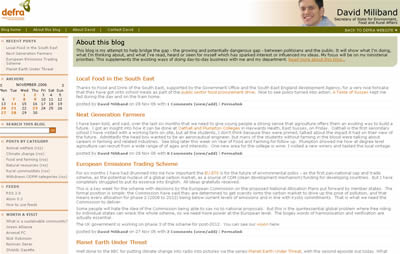
Who is David Miliband? Well, he’s the Secretary of State for Environment, Food and Rural Affairs in the UK and his blog, David Miliband, is right on.

What a great example of non-sexy, government website that seeks public input while putting a face (literally) on the work. And in David's words:

This blog is my attempt to help bridge the gap - the growing and potentially dangerous gap - between politicians and the public. It will show what I'm doing, what I'm thinking about, and what I've read, heard or seen for myself which has sparked interest or influenced my ideas. My focus will be on my ministerial priorities. This supplements the existing ways of doing day-to-day business with me and my department.
Great stuff and maybe one day we can have departmental blogs that give our program work a unique voice too. I’d love to learn of more folks blogging from within, any leads or ideas?

Saturday, November 11, 2006

A call out to Designing Inward Out

Cool stuff. Alan Rosenblatt's blog, Dr. DigiPol: Caring for Politics in the Digital Age, had some nice things to say about what I'm attempting to do here. It was very much appreciated as well as his efforts in the advocacy field to bring folks together for roundtable discussions.

However, I do want to make it clear that though this blog addresses some of the changes within my organization, it is separate from the organization. My intention is to keep the focus on the process of a website redesign and not the organization. Thanks, had to say it again.

This is the stuff that I know about, but I'm sure there's more. Check out some of Alan's work here, here, and here.

Thursday, November 02, 2006

New audio introduction added to the blog

Again, all of this is a testing ground for stuff we're beginning to experiment with as we go through our website redesigns.

The podcast tool I'm using is Gcast. They provides a free service that is extremely easy to use and one that can be done on the fly with a cell phone.

Interviews would be pretty cool. Maybe, I can chat with some of my co-workers as we go through the redesign process or better yet, some of our supporters - possibly even the design consultants, developers, and firms we're working with.

We have though begun testing the use of Gcast internally with field reports and we recently launched a Tim Palmer interview in our monthly newsletter. To date, we've gotten some pretty good feedback from folks.

I like the audio intro, but over the coming weeks I'd like to try a video introduction...in a van down by the river. I have no video editing skills, and in fact, have never attempted to edit video or let alone shoot video. But I'd like to learn as well as test out these.